

Service Hotline:
+86-13526692320- Tel/WhatsApp: +86-13526692320
- E-mail: sales@doinggroup.com
Factory Plastic Waste Recycling Solution: Pyrolysis Technology
Most plastic waste generated by factories never gets a second life. Whether it is plastic scrap from diaper manufacturing, waste from paper mills, or automotive shredder residue, these waste streams are often too heterogeneous, heavily contaminated, or structurally complex for mechanical recycling technologies to handle effectively.
Pyrolysis technology has changed this landscape. Inside an oxygen-free reactor at temperatures between 200 and 450 degrees Celsius, plastic polymers break down into pyrolysis oil, carbon black, and syngas—all of which are usable products rather than waste burdens requiring disposal. Pyrolysis technology can process virtually all industrial plastic waste, with the exception of PVC (polyvinyl chloride) and PET (polyethylene terephthalate).
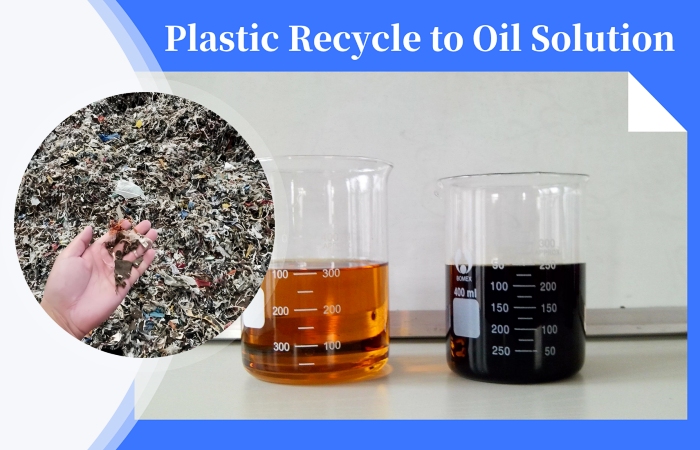 Factory waste plastic to oil recycling pyrolysis solution
1. Which Factories Generate Hard-to-Recycle Plastic Waste?
Industrial manufacturing turns out enormous volumes of plastic waste that conventional recycling systems were never designed to handle. Here is a breakdown of the main sectors and what they produce.
| Industry | Key Plastic Waste |
| Diaper & Sanitary Product Factories | PE/PP nonwoven, SAP absorbent polymer, elastic film — multi-layer off-spec rolls |
| Paper Mills | Fiber-plastic sludge, mixed PE/PP film from pulping — wet with 30–60% moisture |
| Packaging & Logistics | LDPE/LLDPE stretch wrap, multi-layer barrier film, HDPE drums, woven PP bags |
| Automotive Parts | PP bumpers, ABS interior trim, oil-contaminated mixed plastics |
| Textile Mills | Polyester-cotton blended waste, nylon fiber, PP carpet backing |
| Electronics Assembly | ABS/HIPS housing, flame-retardant FR-ABS, PE foam packaging |
| Medical Device Manufacturing | PE/PP cleanroom disposables, tubing and IV bag production rejects |
These factory waste plastics are too contaminated, too mixed, or too structurally complex for mechanical recycling. Until recently, the options were incinerate or landfill — both getting more expensive and more restricted by the year.
2. Why Conventional Recycling Systems Fall Short for Industrial Plastic Waste?
Mechanical recycling needs three things that industrial waste rarely delivers: clean material, single-polymer streams, and minimal contamination.
Multi-layer films and fiber-plastic composites cannot be separated economically. Optical sorters cannot distinguish between layers. Density-based separation fails when plastics overlap. Manual sorting at factory scale is a non-starter.
Contamination from oil, impurities residue, coatings, and embedded non-plastic materials produces mechanically recycled output that is brittle, discolored, and only useful for the lowest-grade applications.
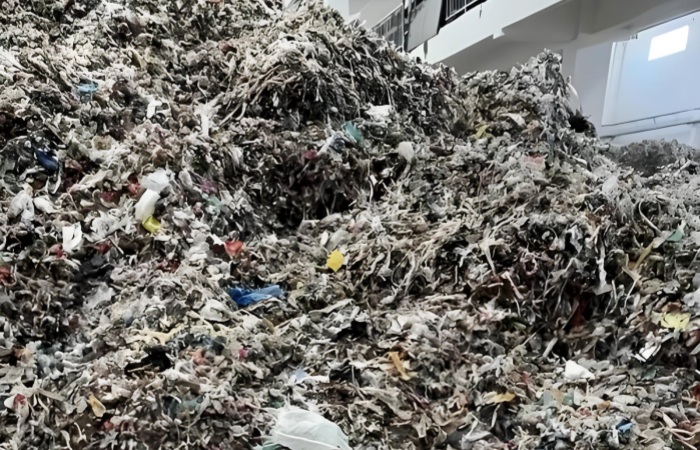 Waste plastic generated from different factories
At the same time, regulations in developed markets are closing off landfill and incineration. The EU Landfill Directive caps municipal waste to landfill at 10% by 2035, with several member states already banning landfilling of combustible waste. The UK Plastic Packaging Tax charges £217.85 per tonne (2025 rate) on packaging with less than 30% recycled content. California, Colorado, Maine, and Oregon all have EPR laws in motion that shift disposal costs back onto brand owners. For a factory producing 500 tonnes of mixed plastic waste annually, disposal costs alone can exceed £50,000 a year at UK rates — before transport and handling.
3. Factory Waste Plastic Pyrolysis Machine: How It Works
Pyrolysis is thermal decomposition in an oxygen-free environment. Plastic polymers are heated to 200–450°C inside a sealed thermal cracking reactor. Without oxygen, the long hydrocarbon chains do not burn. They crack into shorter-chain molecules, producing three streams: pyrolysis oil (liquid hydrocarbons, C5–C20), syngas (non-condensable C1–C4 gases), and carbon black (solid residue).
This is not incineration. Plastic pyrolysis process is an endothermic reaction that makes usable products rather than destroying the material.
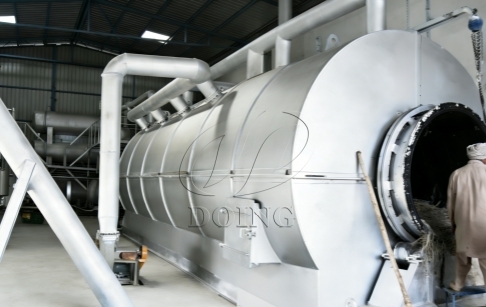
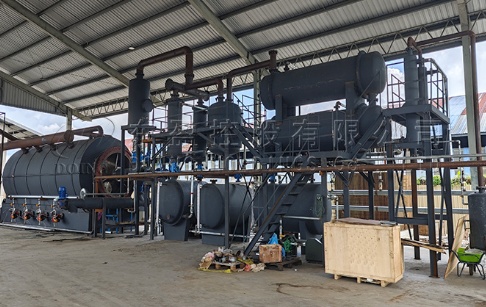
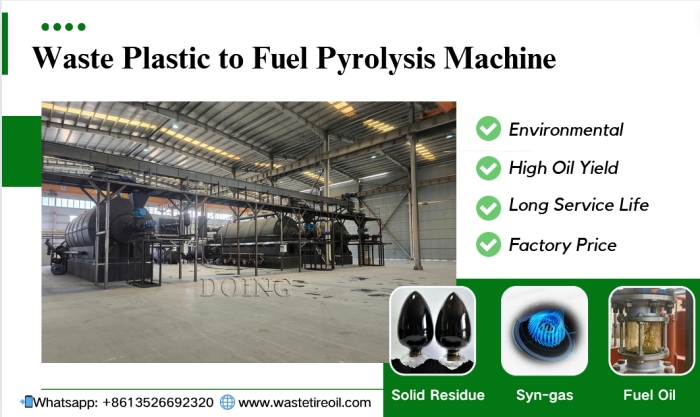 DOING pyrolysis machine for recycling plastic into oil
4. Which Industrial Plastic Scraps Can Pyrolysis Facility Handle?
| Plastic Type | Pyrolysis Compatible | Typical Oil Yield |
| PE (LDPE / HDPE / LLDPE) | Yes | 70–85% |
| PP (Polypropylene) | Yes | 60–75% |
| PS (Polystyrene) | Yes | 80–90% |
| ABS | Yes | 40–55% |
| Mixed PE/PP/PS | Yes | 50–75% |
Diaper / sanitary waste | Yes | 50–65% |
| Paper mill plastic rejects | Yes | 30–60% |
| PVC | No | N/A |
| PET | No | N/A |
5. The Pyrolysis Process of Making Oil&Gas From Waste Plastic
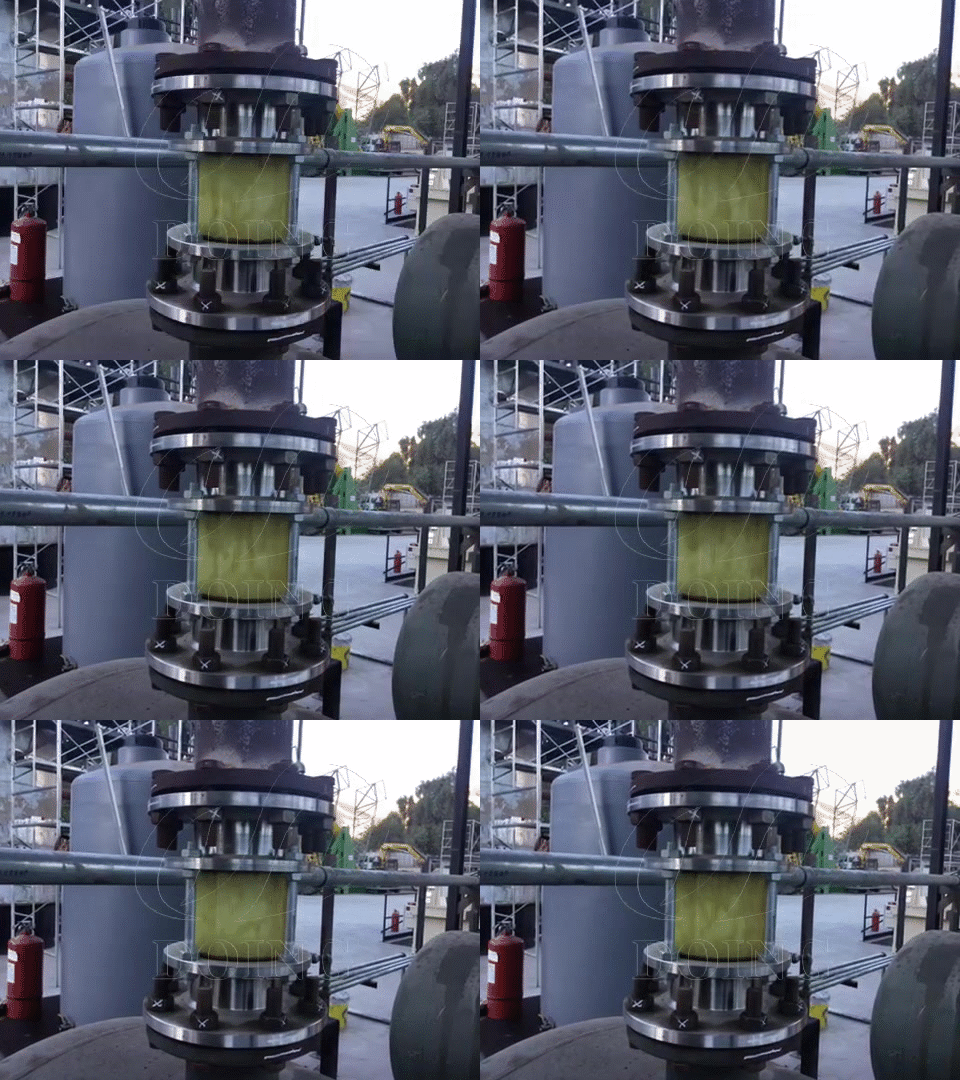
Pyrolysis plastic into oil gas production process is straightforward as the above video showes. Pre-treated industria plastic scrap feedstock enters a heated pyrolysis reactor. As the material reaches cracking temperature, hydrocarbon vapors rise off and pass through a condensation system, where they cool into liquid plastic pyrolysis oil. The gases that do not condense are scrubbed and routed back to heat the reactor — once the system reaches operating temperature, it largely sustains its own energy needs. Solid residue discharged from the reactor cools into carbon black.
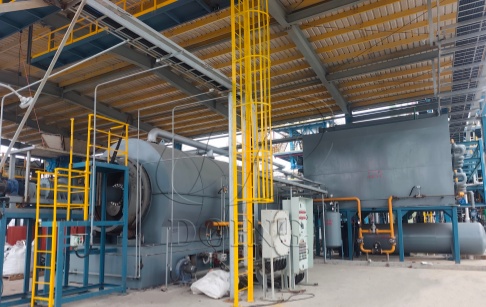
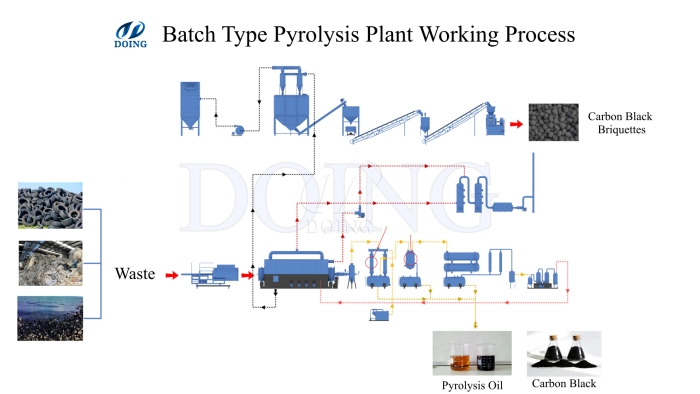 Waste plastic to oil pyrolysis plant working process
6. What You Get: Plastic Pyrolysis Products, Applications and Market Value
| Product | Applications | Market Price(USD/tonne) |
| Pyrolysis Oil | · Industrial boiler fuel | $450–$550 as fuel oil; |
Carbon Black | · Rubber reinforcement (tires,conveyor belts) | $400–$800 for standard and premium-grades |
| Syngas | · Combusted in the pyrolysis stove heating system | Self-consumed, displacing 40–70% of heating energy |
7. Industrial Scrap Plastic Pyrolysis Business and Compliance Case
Plastic pyrolysis machine turns a factory plastic waste disposal cost center into a revenue stream. For factory operators paying landfill taxes and gate fees that run $50–$150 per tonne in OECD markets, on-site or regional pyrolysis eliminates those costs while generating saleable oil and carbon black. The pyrolysis oil qualifies toward chemical recycling targets under the EU Packaging and Packaging Waste Regulation and the UK Plastics Packaging Tax — both accept chemically recycled content under mass-balance chain of custody. A typical plant reaches payback in 1 to 3 years, driven by avoided disposal costs, product revenue, plastic packaging tax avoidance, and available circular economy grants.
Contact Reliable Manufacturer DOING Company For Pyrolysis Solution
If your factory is paying to landfill or incinerate plastic waste, pyrolysis machine is worth a serious look. Henan Doing Company is a specialized manufacturer of industrial pyrolysis equipment with plants operating across Europe, American Countries, Southeast Asia, Africa and the Middle East.
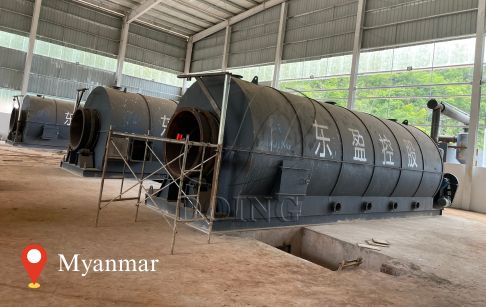
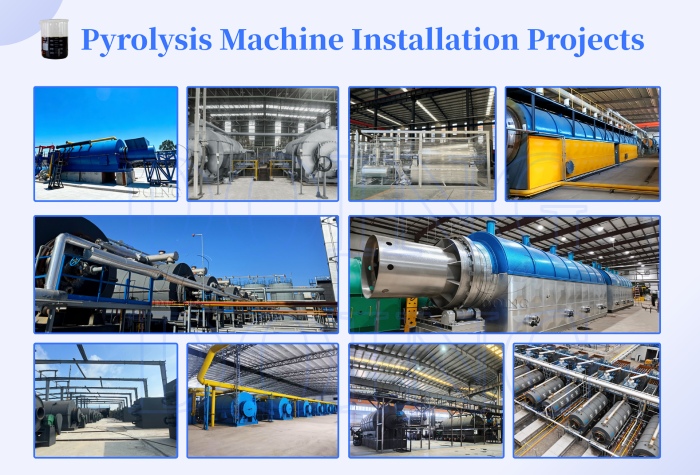 World-wide pyrolysis machine projects installed by DOING Company
We also handle plant design, manufacturing, installation, commissioning, operator training, and emissions documentation for EU and North American permitting. Include your approximate monthly waste plastic volume and main plastic types. DOING engineering team responds within 24 hours with a tailored proposal.
Request a Quote for Pyrolysis Plant
Please leave your contact information and pyrolysis plant requirements so that our professional team can contact you as soon as possible.
- QWhat raw material do you plan to process?
- Rubber tire
- Waste plastic
- Oil sludge
- Biomass
- Waste oil
- Pyrolysis oil
- Not decided yet
- Other:
- QMachine daily processing capacity (tons of feedstock)
- 100kg-2ton
- 5-15ton
- 15-50ton
- >50ton
- Not decided yet
- QDesired final product and its primary applications